ST
UC3842 IC Current Mode PWM Controller UC3842
UC3842 IC Current Mode PWM Controller UC3842
SKU:UC3842
100 in stock
Couldn't load pickup availability
Product Overview
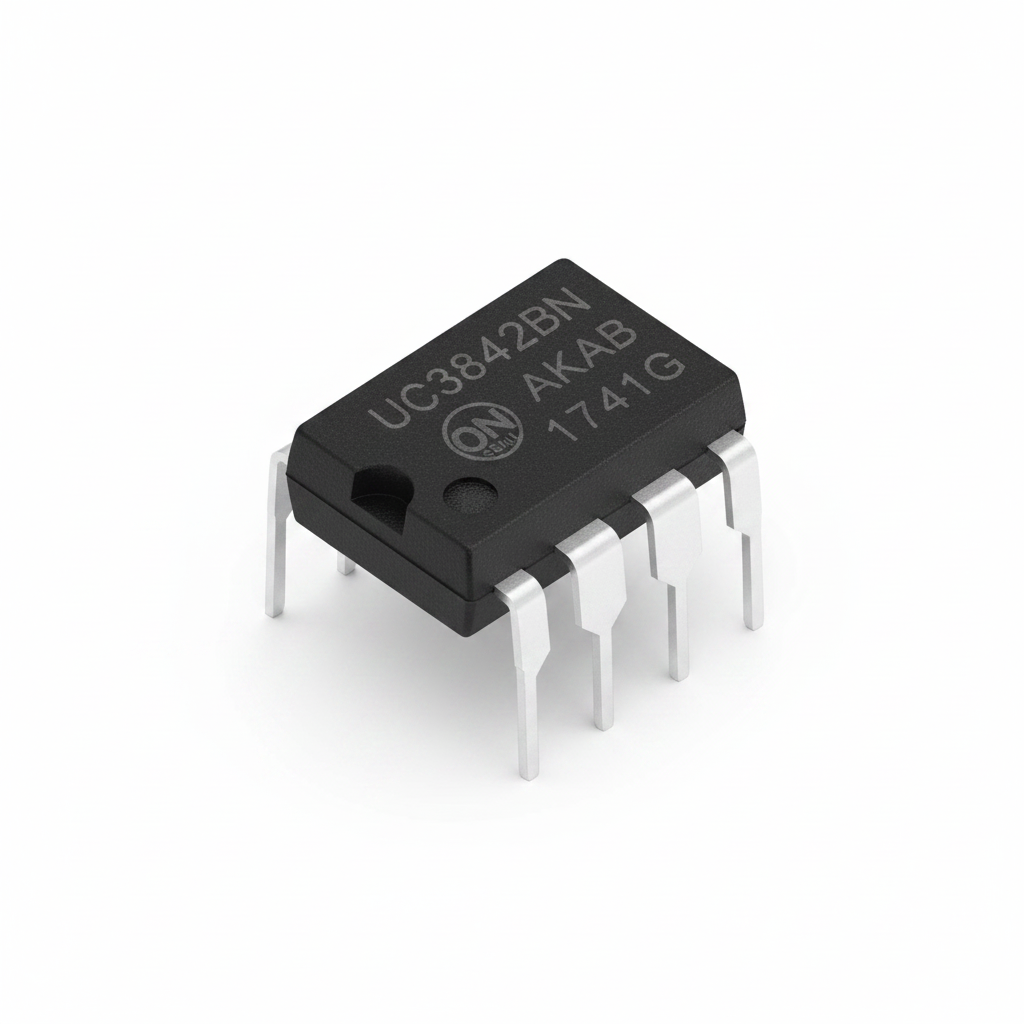
The UC3842 (referenced in an246-uc3842-provides-lowcost-current-mode-control-stmicroelectronics.pdf) is an integrated pulse width modulator (PWM) designed to provide a low-cost, current-mode controller for power supply designs. It is optimized for efficient power sequencing of off-line converters and for driving power MOSFETs.
Key Features
-
Current-Mode Control: The IC provides performance advantages such as instantaneous correction for input voltage variations (line regulation).
-
Current Limiting: Pulse-by-pulse current limiting is inherent in the control scheme, and an upper limit on peak current can be established by clamping the error voltage.
-
Totem-Pole Output: Features a single totem-pole output capable of $\pm 1\text{ A}$ peak current and $\pm 200\text{ mA}$ average current.
-
Under-Voltage Lockout (UVLO): Includes a UVLO circuit with fixed internal thresholds (16 V turn-on and 10 V turn-off) and 6 V hysteresis to prevent oscillations.
-
PWM Latch: Ensures that only a single pulse appears at the output in any one oscillator period.
-
Parallel Operation: Current-mode controlled power stages can be operated in parallel with equal current sharing.
Operating Characteristics
-
Supply Voltage: The device operates from a low-impedance DC source of 10 V to 30 V.
-
Start-up Current: The start-up current is less than 1 mA, allowing for efficient bootstrapping.
-
Oscillator: Timing is programmed via an external resistor ($R_T$) and capacitor ($C_T$).
-
Error Amplifier: Includes an internally biased non-inverting input ($2.5\text{ V} \pm 2\%$) and an output available for external compensation to control the converter’s closed-loop frequency response.
-
Frequency Limits: While the device can operate in topologies up to 500 kHz, performance advantages often diminish above approximately 250 kHz due to current sense delays and deadtime constraints.