TM(Shenzhen Titan Micro Elec)
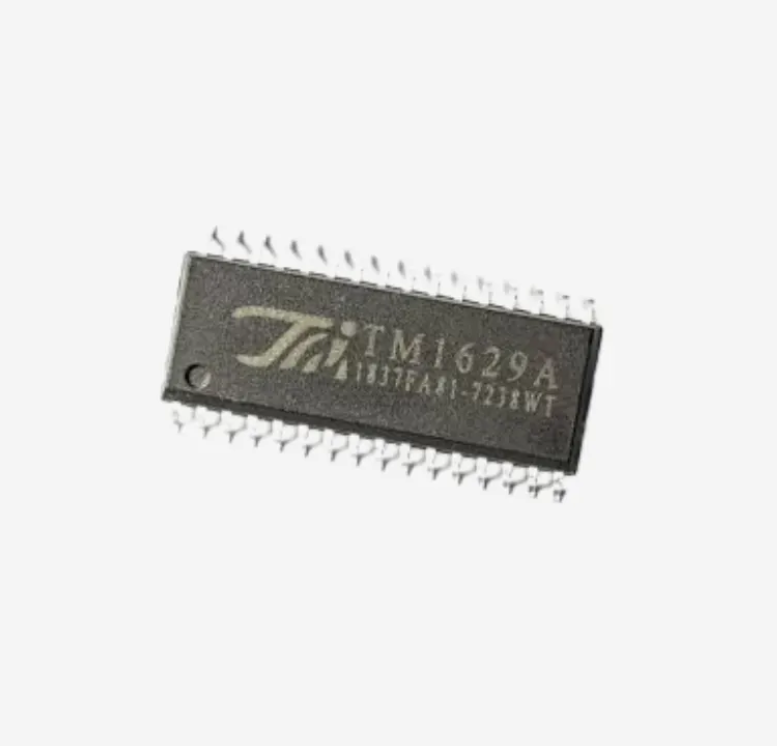
TM1629C SMD IC Digital display driver IC 7 SEGMENT SOP32 TM1629C
TM1629C SMD IC Digital display driver IC 7 SEGMENT SOP32 TM1629C
SKU:TM1629C
100 in stock
Couldn't load pickup availability
Product Overview:The TM1629C is a specialized LED driver and keyboard scanning controller, similar to the TM1629B, but optimized for slightly different display configurations. It is primarily designed for high-segment display applications in home appliances.
Core Specifications
-
Manufacturer: Titan Micro Electronics (TITAN MICRO)
-
Package: SOP32
-
Display Capacity: 15 segments × 8 digits.
-
Keyboard Scanning: 8 × 1 bit matrix.
-
Control Interface: 3-wire synchronous serial interface (CLK, STB, DIO).
-
Brightness Control: 8-level duty cycle adjustment.
Key Differences & Functional Notes
-
Display Addressing: The TM1629C uses addresses C0H to CFH for its 16-byte display register.
-
Keyboard Matrix: Unlike the TM1629B (which uses an 8x2 matrix), the TM1629C uses an 8x1 bit keyboard scan matrix.
-
Electrical Requirements:
-
It operates on a logic supply voltage of 5V.
-
DIO Pull-up: When reading keys, you must connect an external pull-up resistor (1kΩ to 10kΩ) to the DIO line; the manufacturer recommends 10kΩ.
-
Timing: When reading data, there is a required wait time of at least 2µs between the command and data readout.
-
Design Considerations
-
Multiplexing: The device utilizes an N-channel open-drain output for Grids (GRID1–GRID8) and a P-channel open-drain output for Segments (SEG1–SEG15).
-
PCB Layout: To ensure stable operation, keep the filter capacitors between $V_{DD}$ and GND as close to the chip as possible.
-
Noise Reduction: Adding a 100pF capacitor to the DIO, CLK, and STB lines is recommended to minimize interference on the communication pins.
For complex systems, ensure you follow the address auto-increment or fixed-address programming flows as outlined in the provided documentation to correctly map your LED segments to the specified register addresses.